
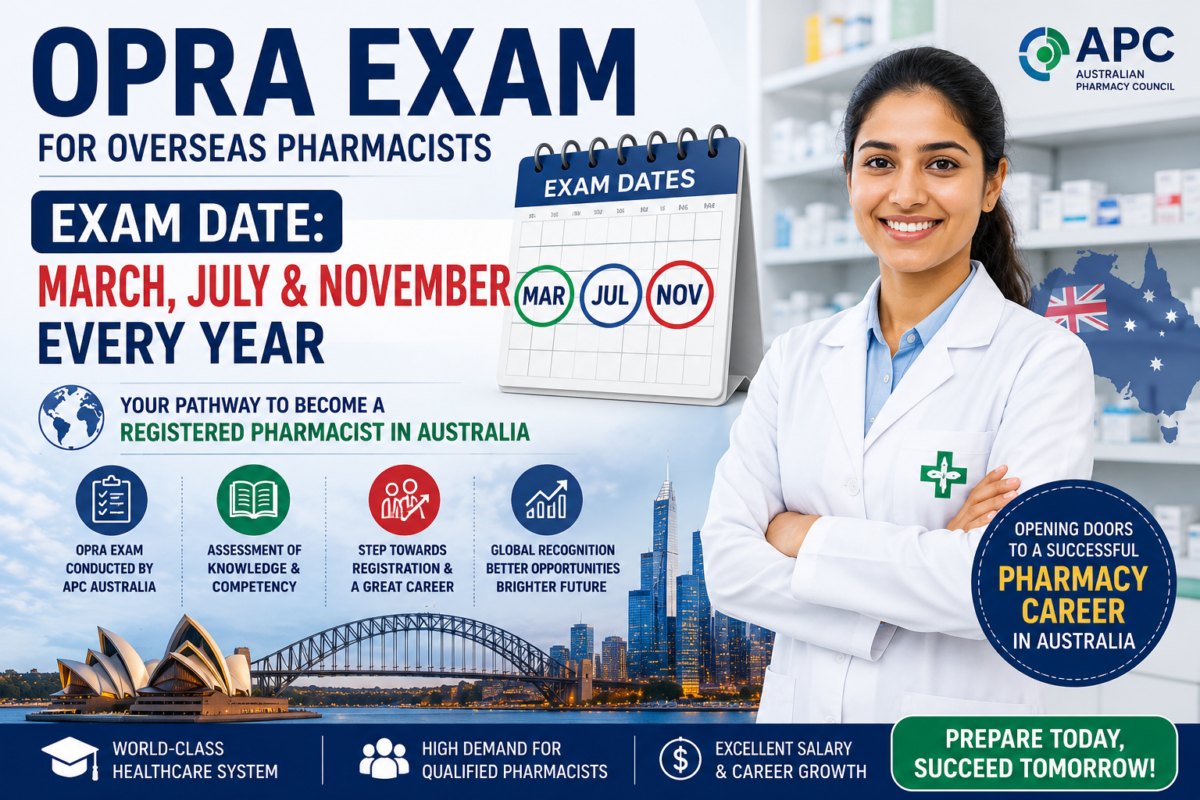
Passing OPRA Exam for Pharmacist Unlocks Career in Australia
For internationally qualified pharmacists, Australia continues to be one of the most attractive destinations for professional growth and long-term career opportunities. Indeed, passing OPRA Exam for Pharmacist unlocks career in Australia by helping overseas-trained pharmacists begin the registration pathway toward becoming a registered pharmacist in Australia.
The Overseas Pharmacist Readiness Assessment, that is OPRA, has replaced the previous KAPS examination and is designed to assess whether overseas pharmacists possess the knowledge and skills required for pharmacy practice in Australia. Therefore, understanding the examination process, eligibility requirements, syllabus, and exam schedule is essential for success.
What is the OPRA Exam?
The Overseas Pharmacist Readiness Assessment, that is OPRA, is a competency-based assessment developed to evaluate the readiness of internationally qualified pharmacists seeking registration in Australia.
Importantly, the OPRA exam for pharmacist is conducted by APC Australia, ensuring that candidates meet the professional standards expected within the Australian healthcare system. The examination assesses pharmaceutical sciences, therapeutics, patient care, pharmacy practice, and clinical decision-making skills relevant to modern pharmacy practice.
Furthermore, as the registration pathway evolves, the OPRA exam for pharmacist is conducted by APC Australia to support a streamlined assessment process for pharmacists trained outside Australia and New Zealand.
Passing OPRA Exam for Pharmacist Unlocks Career in Australia
Many international pharmacists choose Australia because of its strong healthcare system, competitive salaries, and excellent quality of life. As a result, Passing OPRA Exam for Pharmacist unlocks career in Australia by serving as a key milestone in the pharmacist registration pathway.
After successfully completing the examination and fulfilling other registration requirements, candidates can continue toward supervised practice and eventual pharmacist registration. Moreover, for many professionals, Passing OPRA Exam for Pharmacist unlocks career in Australia and provides opportunities in community pharmacy, hospital pharmacy, research, and pharmaceutical industries.
OPRA Exam Dates: March, July and November Every Year
One of the most important pieces of information for candidates is the examination schedule. Fortunately, the OPRA exam dates: March, July and November every year, allowing candidates multiple opportunities to sit the assessment.
Additionally, since the OPRA exam dates: March, July and November every year, candidates can strategically plan their preparation and registration timeline. Early planning helps ensure sufficient time for eligibility assessment, document verification, and exam preparation.
Furthermore, prospective candidates should remember that the OPRA exam dates: March, July and November every year, and registration deadlines are usually announced well in advance by the Australian Pharmacy Council.
Why Knowing the OPRA Exam Dates Matters
Because the OPRA exam dates: March, July and November every year, pharmacists can choose a testing window that best aligns with their preparation schedule. Consequently, this flexibility helps candidates manage professional commitments while preparing effectively for the assessment.
OPRA Exam Syllabus by Australian Pharmacy Council
Understanding the OPRA Exam syllabus by Australian Pharmacy Council is essential for effective preparation. In particular, the examination focuses on knowledge areas required for safe and effective pharmacy practice.
The OPRA Exam syllabus by Australian Pharmacy Council generally includes:
- Pharmaceutical sciences
- Pharmacology
- Therapeutics
- Clinical pharmacy
- Pharmacy practice
- Patient counseling
- Medication management
- Professional and ethical responsibilities
- Public health concepts
Therefore, candidates should thoroughly review the OPRA Exam syllabus by Australian Pharmacy Council and align their study plan with the official competency framework provided by APC.
OPRA Exam Eligibility Criteria for Overseas Pharmacists
Before applying, candidates must understand the OPRA Exam Eligibility Criteria for overseas pharmacists.
Generally, the OPRA Exam Eligibility Criteria for overseas pharmacists require candidates to:
- Hold an approved pharmacy qualification obtained outside Australia.
- Meet document verification requirements.
- Complete the skills assessment process where applicable.
- Fulfill APC assessment requirements.
Consequently, understanding the OPRA Exam Eligibility Criteria for overseas pharmacists early can help candidates avoid delays in the registration process.
OPRA Exam Qualification Process for Australia and New Zealand
The OPRA Exam Qualification process for Australia and New Zealand is designed to assess the readiness of internationally trained pharmacists.
Typically, the OPRA Exam Qualification process for Australia and New Zealand includes:
Step 1: Eligibility Assessment
Firstly, candidates submit educational and professional documents for assessment.
Step 2: Skills Assessment
Next, APC evaluates qualifications and determines eligibility for the examination pathway.
Step 3: OPRA Examination
Thereafter, eligible candidates sit the OPRA examination.
Step 4: Registration Pathway
Finally, successful candidates continue through internship, supervised practice, and registration requirements depending on jurisdictional requirements.
Thus, understanding the OPRA Exam Qualification process for Australia and New Zealand helps candidates prepare for each stage systematically.
Register for OPRA Exam Through Australian Pharmacy Council
To participate in the examination, candidates must Register for OPRA exam through Australian Pharmacy Council following the official application procedures.
The process generally involves:
- Creating an APC account.
- Submitting qualification documents.
- Completing eligibility assessments.
- Receiving examination approval.
- Selecting an available examination session.
- Paying the applicable fees.
Therefore, candidates should always Register for OPRA exam through Australian Pharmacy Council using official channels and carefully follow all instructions provided during the application process.
Why APC Plays a Critical Role
The OPRA exam for pharmacist is conducted by APC Australia, making APC responsible for maintaining examination standards and ensuring candidates meet Australian professional expectations.
Similarly, because the OPRA exam for pharmacist is conducted by APC Australia, candidates should regularly review APC announcements regarding examination schedules, eligibility requirements, and syllabus updates.
Preparing Successfully for the OPRA Examination
A successful preparation strategy should include:
- Reviewing the OPRA Exam syllabus by Australian Pharmacy Council
- Practicing clinical and therapeutic case-based questions
- Understanding Australian pharmacy practice standards
- Developing time-management skills for computer-based testing
- Staying updated on APC examination guidelines
In addition, candidates who thoroughly prepare and understand the examination structure significantly improve their chances of success.
Final Thoughts
The Overseas Pharmacist Readiness Assessment, that is OPRA, represents a major step toward pharmacist registration in Australia. Since the OPRA exam dates: March, July and November every year, candidates have multiple opportunities to plan their preparation effectively.
By carefully understanding the OPRA Exam Eligibility Criteria for overseas pharmacists, reviewing the OPRA Exam syllabus by Australian Pharmacy Council, completing the OPRA Exam Qualification process for Australia and New Zealand, and ensuring they Register for OPRA exam through Australian Pharmacy Council, candidates can confidently progress toward their professional goals.
Most importantly, Passing OPRA Exam for Pharmacist unlocks career in Australia, opening doors to rewarding opportunities within one of the world’s most respected healthcare systems.
